Mass Union Fall 2023 Convention

Sponsored by
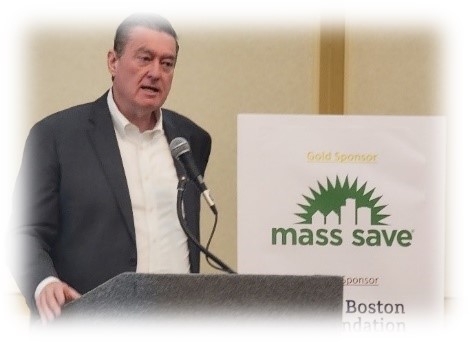
Mass Save Logo, Savings through Energy Efficiency  

October 28, 2023
Best Western, Royal Plaza Hotel & Trade Center
181 Boston Post Road, Marlborough, MA

Registration and Continental Breakfast will begin at 8am
Programming will begin at 10am and wrap up at 5pm

Spanish Interpretation will be provided

Convention Flyer

Spanish Convention Flyer

  • Meet other tenants from across the state and celebrate Spaghetti Power!
  • Help advance our goal to improve quality of life in public housing
  • Hear from the Executive Office of Housing and Livable Communities (formerly DHCD)
  • Participate in workshops to gain new knowledge and skills you can bring back to your community
  • Full Agenda and Workshop Options

Thank You to Our Sponsors!

Gold Sponsor

Bronze Sponsor Resident Patrons
Sending 10+ Residents

Resident Sustainers
Sending 5+ Residents

Resident Sponsors
Sending 2+ Residents

Attleboro Housing Authority
Cambridge Housing Authority
Easthampton Housing Authority
Northampton Housing Authority
Watertown Housing Authority

Mass Union’s 2023-2024 Policy Agenda

Mass Union’s Policy Agenda – Summary

October 10, 2023

      1. Address the dangerous backlog of capital needs in public housing.
      2. Protect tenants during Redevelopment.
      3. In future budget cycles, fund the operating subsidy at needed levels.
      4. In state housing, increase Tenant Participation Funding to $25/unit/year.
      5. Enforce LTO participation regulations.
      6. Enforce and improve grievance regulations.
      7. Require resident participation in choosing LHA management agreements.
      8. Improve rent certification requirements in light of tenant privacy.
      9. Provide Access to Counsel.

In Detail

1. Address the dangerous backlog of capital needs in public housing.

With our partners, Mass Union has identified $8.5 billion in deferred capital needs in the state’s public housing portfolio. Residents live with this backlog every day. Mold, pests, leaks, broken infrastructure, unsafe fire systems, backed up plumbing and sewage systems, and decades-old appliances are the norm. Fire alarms go off for days at a time. Mold is visible on walls. Asbestos goes unaddressed. The health and safety of the residents are clearly being compromised and too many units are close to unlivable.

The current infusion of about $500 million in capital upgrades per year will not preserve the state’s investment in public housing. We urge the Administration to develop a robust plan with stakeholders to ensure that the state’s 43,000 units remain online by proposing a substantial 5-year bond, by seeking additional ARPA funding from the legislature, and by making every attempt to bring vacant housing back online as authorized by Line Item 7004-9005 and as provided by Public Housing Notice 2016-34 and now 2023-17.

2. Protect tenants during Redevelopment.

In light of the capital backlog and incentives to bring private dollars into the mix, it is essential to protect tenants both during the redevelopment process and to ensure that they retain the same rights after its completion. We urge the Administration to support S. 857/ H. 1340, An Act ensuring continued rights for public housing residents. For testimony, section-by-section, fact sheet and an updated 2023 Public Housing Redevelopment Bill of Rights, which articulates the principles of good redevelopment, click here.

We further urge EOHLC to include in its upcoming new Public Housing Redevelopment NOFA that there be a requirement in the NOFA that tenants be provided with technical assistance so that they can have meaningful input into the redevelopment process.

3. In future budget cycles, fund the operating subsidy at needed levels.

Mass Union and our partners have determined that fully funding public housing would require $184 million from the Operating Subsidy. While we are grateful for this year’s increase from $92 million to $107 million, we will continue to advocate for full funding in future budget cycles.

4. In state housing, increase Tenant Participation Funding to $25/unit/year.

Tenants are key partners in the oversight of public housing. To ensure that their perspective is adequately represented in decision-making, they need to form and sustain Local Tenant Organizations. As the regulations state: “The purpose of 760 CMR 6.09 is to encourage the formation of representative organizations and to provide all residents the opportunity to be heard on and participate in matters affecting the interests of the residents.” This requires funds for expenses such as printing, translation, elections, education, training, convenings and more. The federal government allocates $25/unit/year, over four times as much as the state provides for Tenant Participation Funds, which stands at $6/unit/year.

Mass Union respectfully requests that the state match the federal allocation of $25/unit/year for this function. With Mass Union’s assistance, this relatively modest investment in oversight can have an outsize impact in tenants’ ability to provide crucial insights at their Housing Authorities.

5. Enforce LTO participation regulations.

EOHLC has issued very good regulations to allow for the formation, recognition, and participation of Local Tenant Organizations. Mass Union’s main focus is supporting tenants to make use of these regulations. In many cases, tenants run into barriers when invoking their rights to have:

  • Quarterly meetings with the Executive Director (6.09(3)(a))
  • An opportunity to be heard at LHA Board Meetings (6.09(3)(o))
  • Prompt appointment of LTOs’ nominees to the LHA Board (PHN 2021-01)
  • Participation in hiring (6.09(3)(n)) and redevelopment (6.09(3)(i))
  • Negotiating Memorandums of Understanding between LHA and LTO (6.09(3))
  • Allocation of their Tenant Participation Funds (6.09(3)(c))
  • Office (6.09(3)(d)) and meeting space (6.09(3)(f))
  • Their LTO by-laws (6.09(2)(d)) and other policies posted (6.09(3)(l))

Tenants routinely ask what the recourse is when Housing Authorities fail to comply with 760 CMR 6.09. We seek EOHLC’s input and help in addressing this situation.

6. Enforce and improve grievance regulations.

Similarly, tenants often encounter barriers when they attempt to file grievances, which is their regulatory right. A functioning grievance process is essential to resolve matters in a fair, prompt and reliable way.

Many tenants are unaware that there is a grievance process or fear retaliation if they file a grievance. Executive Directors sometimes fail to “accept” grievances when tenants initiate them, and the process does not move forward. Tenants raise concerns about grievance hearing panel members not being perceived as impartial, as the regulations require. Some Executive Directors have also appointed themselves as the grievance officer at their Housing Authority, in violation of the regulations. It is unclear what steps residents can take when a grievance procedure is not in place or not properly operating.

Mass Union requests that EOHLC issue a notice clarifying the existing grievance regulations including clarifying that 1. grievance panel members must be impartial; 2. LHA staff from other LHAs should not be allowed to serve as grievance officers or on panels; and 3. if the grievance process repeatedly fails to produce fair and prompt determinations then EOHLC will deem it deficient and determine a plan of action. EOHLC should also ensure that every Housing Authority has a grievance policy on the books and that it is posted and publicized according to the regulations. These metrics could be part of the PMR.

7. Require resident participation in choosing LHA management agreements.

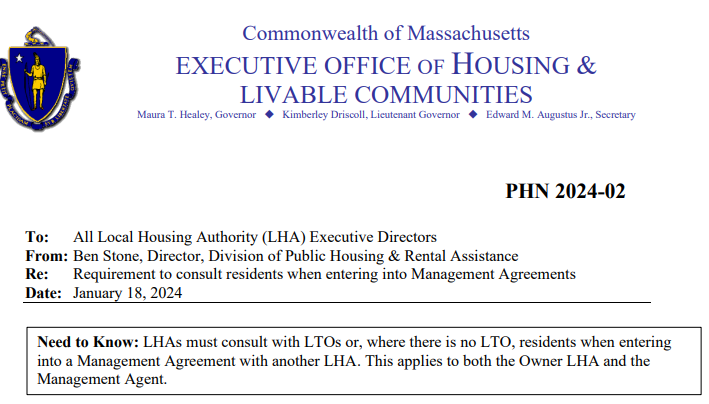
Tenants have a right to participate in the hiring of any staff with whom they have direct contact, including Executive Directors. More and more, Housing Authorities are choosing to enter into management agreements in lieu of hiring their own EDs. However, there is no provision for resident participation in the negotiation of such agreements, despite the fact that tenants are demonstrably impacted by them. EOHLC should ensure that tenants have a voice when their Housing Authority is considering entering into such an agreement as either the party being managed or doing the managing. Both sides of the coin impact the allocation of resources at the HA, and thus the welfare of tenants.

Read our memo to EOHLC about requiring tenant participation in management agreements (PDF).

8. Improve rent certification requirements in light of tenant privacy.

During the rent recertification process, tenants are often asked to provide bank statements. In some cases, they are instructed by the Housing Authority to include all pages and refrain from redacting personal information, such as account numbers.

Mass Union supports fair and transparent rules for rent recertification and we ask EOHLC to issue guidance to clarify that an LHA may only ask the tenant for bank statements as third-party verification in the event that the “LHA finds that the initial documentation provided by the tenant is not adequate.” In other words, LHAs should not automatically ask tenants at the first instance to provide 12 months or years of bank statements. Guidance should require the LHA to make a clear finding that the documentation provided by the tenant was not adequate. In addition, guidance should limit the LHA requests for bank statements to 2-3 statements and make explicit that the tenant may redact the bank statement to only show relevant income information and may redact other information on the statement that is private.

9. Provide Access to Counsel.

Mass Union is part of the broad coalition supporting Access to Counsel, which includes municipal leaders. Every week, Mass Union gets calls from tenants facing eviction and there is nothing we can do to help. Access to counsel for very vulnerable tenants who face eviction is a life changer, and could potentially also help those tenants before court during grievance proceedings. In virtually 100% of public housing cases, Housing Authorities have legal representation, while 95% tenants do not have the benefit of legal representation. Tenants in public housing are scared and intimidated when they have to go to court alone. We urge the Administration to support Access to Counsel bills before the Legislature in order to provide equity in representation.

Online Training Series: Sustaining a Strong Local Tenant Organization

  • For public housing residents
  • Choose between the Tuesday Morning or Wednesday Evening series (see below)
  • Via Zoom

This five-part training series will help you build confidence and skills to manage a successful Local Tenant Organization (LTO). Starting and sustaining an LTO is a lot of work, but Mass Union, MKI and our network of fellow tenants are here to help! Whether you are a seasoned leader or just getting started, join us to share tips, tricks and encouragement. We’ll talk about:

  • Why to form a Local Tenant Organizations – and why not to!
  • Leadership do’s and don’ts
  • The rights and responsibilities of Local Tenant Organizations
  • How to reach and engage other tenants by overcoming fear
  • How to build power and voice to win changes at your Local Housing Authority

Please note that you can attend either the morning or evening series. The content will be the same.

Please contact Lisa Copeland to register at lisa@massunion.org.

These training series are being offered as part of our partnership with the Mel King Institute. Read more here.

Thank You to Our Sponsors!

Gold Sponsor

Bronze Sponsor

Resident Patrons
Sending 10+ Residents

Resident Sustainers
Sending 5+ Residents

Resident Sponsors
Sending 2+ Residents

Attleboro Housing Authority
Easthampton Housing Authority
Northampton Housing Authority
Cambridge Housing Authority
Watertown Housing Authority

Convention Agenda and Workshop Options

8:00 AM – 9:45 AM – Continental Breakfast (Ballroom Foyer)

8:00 AM – 1:00 PM – Convention Registration (Lobby)

10:00 AM – 12:00 PM – Morning Plenary (Salon DE)

  • Special Speaker: Ed Augustus, Massachusetts Secretary of Housing and Livable Communities (EOHLC)
  • Reports from the Personnel, Finance, Membership and Policy Committees
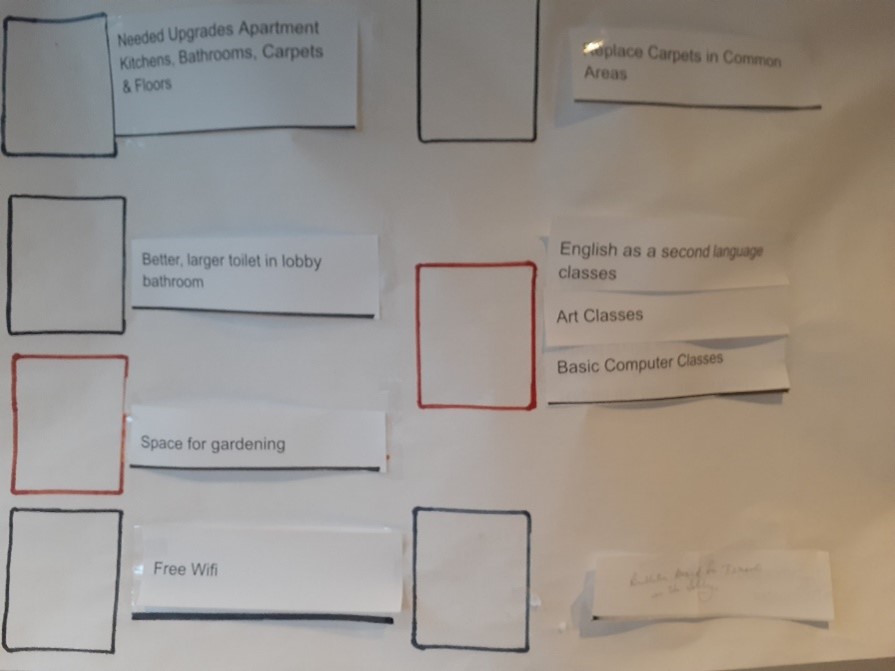
  • Mass Union Policy Agenda Priority Setting Exercise

12:00 PM – 1:15 PM – LUNCH (Courtyard)

1:30 PM – 2:45 PMWORKSHOP OPTIONS

Using Your Grievance Process
Princess
Spanish translation available | Traducción al español disponible

A grievance procedure is a process to resolve disputes between residents in public housing and a Housing Authority. It is a way to work out problems without having to go to court. As a tenant, you have a right to use the grievance procedure to oppose some action that a Housing Authority wants to take against you, or to hold your Housing Authority accountable for the way they have acted or not acted. Many residents are unaware of this right! Join us to review your grievance rights, the process for filing grievances, and how to troubleshoot barriers you may encounter in the process.

Presenters: Annette Duke, Staff Attorney, Mass Law Reform Institute; Lori Manzo, President, Revere City-Wide Tenant Council; Mac McCreight, Attorney, Greater Boston Legal Services

Tenant Perspectives on LHA Management Agreements
Duchess

More and more, Housing Authorities are choosing to enter into management agreements with nearby LHAs in lieu of hiring their own Executive Directors. However, there is no provision for resident participation in the negotiation of such agreements, despite the fact that tenants are impacted by them. Mass Union believes this should change. Tenants have had both positive and negative experiences with management agreements. Join us to hear about both types of experiences, and to share your own perspective on this topic.

Moderator: Ben Echevarria, Mass Union Director of Organizing; Presenters: Judy O’Kulsky, President, Town Wide Belchertown Tenant Organization and Mass Union Network Leader; Maryanne Potrzuski, President, Winthrop Terrace Tenant Organization and Mass Union Board Member

“Ask the Attorneys”
Salon DE
Spanish translation available | Traducción al español disponible

Modeled on the popular session offered at each MassNAHRO Convention, this session will be a chance to ask Legal Aid attorneys your questions. Submit your questions in advance to info@massunion.org, or in writing at the Convention (we will provide index cards). Please submit general questions that the whole group may learn from.

Moderator: Sarah Byrnes, Executive Director, Mass Union; Presenters: Laura Camara, Directing Attorney of Housing Advocacy, South Coastal Counties Legal Services; Susan Hegel, Attorney, Cambridge and Somerville Legal Services; Chhaya Kotwani, Staff Attorney, Housing Unit, Greater Boston Legal Services; Mary Lu Mendonca, Staff Attorney, Housing Unit, Greater Boston Legal Services

2:45 PM BREAK

3:00 PM – 4:15 PMWORKSHOP OPTIONS

Local Tenant Organizations and Resident Participation
Princess

According to EOHLC, resident participation in decision-making at the Housing Authority is beneficial and should be encouraged. Join us for a review of your participation rights as well as tips for running a strong, impactful Local Tenant Organization (LTO). We’ll include tips for using the “Dot Exercise” to prioritize issues in a way that strengthens the LTO’s group cohesion.

Presenters: Ben Echevarria, Director of Organizing, Mass Union; Sue Kirby, President, Morency Tenants Organization and Mass Union Network Leader

Race, Class and Belonging
Duchess
Spanish translation available | Traducción al español disponible

Public housing is beautifully diverse. Join this session to reflect and learn about the role race and class play in public housing and Local Tenant Organizations. We’ll focus on how to ensure that your tenant group is “radically inclusive” so that everyone feels like they belong, regardless of their race, language, religion, ethnicity, age, sexual orientation, (dis)ability, or any other factor.

Moderator: Danielle Connolly, Vice President, Stoneham Housing Resident Union and Mass Union Board Member; Presenters: Maria Fernandes-Dominique, Trainer and Facilitator; Sonia Andujar, Trainer and Facilitator and Mass Union Treasurer; Tiana Lawrence, Trainer and Facilitator

Redevelopment of Public Housing
Salon DE
Spanish translation available | Traducción al español disponible

Due to decades of deferred maintenance, public housing is in tough shape. While Mass Union continues to fight for adequate public investment in housing, “redevelopment” of public housing is also happening – sometimes in partnership with private, for-profit developers. In some cases, ownership moves to a new entity. Join this session with attorneys and residents to learn about Mass Union’s “Bill of Rights for Redevelopment,” which outlines how residents must have a voice in the whole redevelopment process and how they can retain all their rights post-development.

Moderator: Sarah Byrnes, Executive Director, Mass Union; Presenters: Shannon Bailey, President, Lee Fort Terrace LTO; Annette Duke, Staff Attorney, Mass Law Reform Institute; Susan Hegel, Attorney, Cambridge and Somerville Legal Services; Chhaya Kotwani, Staff Attorney, Housing Unit, Greater Boston Legal Services; Mary Lu Mendonca, Staff Attorney, Housing Unit, Greater Boston Legal Services

4:15 – 5:00 PM – Closing Plenary and Raffles (Salon DE)


Mass Union Speaks at Housing Bond Bill Release Event

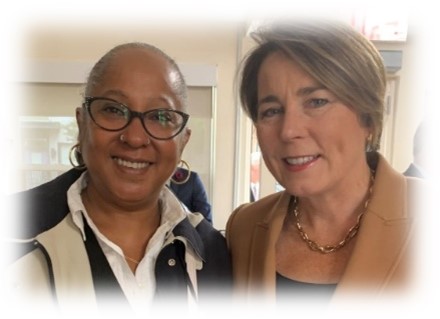
Mass Union Board Member Nicole Beckles gave remarks at the release of the Healey-Driscoll Administration’s new Housing Bond Bill, called the Affordable Homes Act. Mass Union is encouraged by news about the bill and looks forward to reading it in full. See photos and statement below. Congratulations to Nicole and Mass Union!

Statement on the bill’s release: The Mass Union of Public Housing Tenants wishes to thank the Healey-Driscoll Administration and Secretary Augustus for the proposed bond bill’s significant investment in public housing. For decades, public housing has been drastically underfunded. Mass Union has members across the state live with deplorable, unsafe conditions, including leaks, mold, asbestos, and more. Many residents are losing hope that things will change. But today we are grateful to the Healey Administration for taking a huge first step with this investment, for listening to tenants, and for including important tenant protections in the bill.

See more photos and video on our Facebook group!

Mass Union Meeting with Housing Secretary Ed Augustus

On September 27, members of the Mass Union board, staff and affiliates met with the Massachusetts Secretary of Housing, Ed Augustus. We spoke about seven of our policy priorities. The Secretary heard us out and we are excited to continue working together to address our concerns about capital repair needs (such as mold, asbestos, leaks, etc.) and to ensure that tenants have a voice in all the decisions that impact them. Please contact Mass Union’s Director of Organizing Ben Echevarria for more information or to get involved: ben@massunion.org.

Mass Union to the Boston Globe: Tenants who live public housing problems 24/7 urge state to act

Vice Chair Dave Underhill receiving the Bill King award at the Spring 2023 Convention

Mass Union Vice-Chair Dave Underhill published a Letter to the Editor today in the Boston Globe. Dave said:

The chronically broken elevator at an apartment building in the South End isn’t an isolated story (“She needed a lift, but she was let down,” Metro, Sept. 25). We at the Massachusetts Union of Public Housing Tenants know stories like these because we experience these conditions every day. As the Globe’s Sept. 22 editorial pointed out, big problems plague our state’s public housing.

We tenants live these problems 24/7. In state housing, pests, leaks, broken infrastructure, unsafe fire systems, backed-up plumbing and sewage systems, and decades-old appliances are the norm. Fire alarms go off for days at a time. Mold is visible on walls. Asbestos goes unaddressed. The health and safety of the residents are being compromised, and too many units are close to unlivable. Stopgap measures are merely expensive bandages on a gushing wound.

Advocates estimate that we need 190,000 more units of affordable housing to address the housing crisis in Massachusetts. The last thing we need is to jeopardize the state’s existing 43,000 units of public housing by continuing to ignore the dangerous backlog of capital needs.

As the voice of public housing tenants in Massachusetts, we urge the administration to prioritize both the production and preservation of low-income housing, including public housing, to ensure that everyone in the state can live in a safe and affordable home.

See the letter here, along with a letter from our friends at the Greater Boston Interfaith Organization (GBIO). Congratulations to Dave and Mass Union!

Vacant Unit Victory

The state’s waitlist for public housing has climbed to an astonishing 184,000 people. The state manages 43,000 units of public housing but only about 3,000 units turn over per year. Massachusetts is also experiencing a shelter crisis and housing advocates have identified the need for 190,000 more affordable homes. In other words, housing is desperately needed.

Meanwhile, 2,300 public housing apartments are sitting vacant or offline, as reported in great detail by WBUR.

In a recent meeting with the Executive Office of Housing and Livable Communities (EOHLC; formerly DHCD), Mass Union and its members brought the issue of vacant units to the attention of key staff. Our partners have also been highlighting this issue and our attorney, Annette Duke, was interviewed on WBUR about this topic.

These efforts have resulted in new action by the state. On September 22, EOHLC announced a new initiative that will provide money and technical assistance to LHAs in order to get more units back online. EOHLC is making a 90-push to assist in reoccupying units.

Mass Union’s Executive Director, Sarah Byrnes said “Our members, who are public housing residents, are frustrated to see vacant unused apartments. They know that these these apartments are desperately needed and they were able to bring this issue to key decision-makers.”

“Mass Union would like to thank EOHLC for taking action to restore vacant units for occupancy,” added Byrnes. “We applaud this initiative and look forward to ensuring that the new funds and assistance effectively accomplish the goal of bringing units back online and housing people who need it.”

Media Coverage

Listen to Mass Union’s attorney Annette Duke on WBUR talk about the vacant unit crisis and how public housing can help.

Read WBUR’s full report on vacant units here and find out how many units are offline in your community with an interactive map: “Mass. has a huge waitlist for state-funded housing. So why are there 2,300 vacant units?”