
The Blueprint for Change

In public housing, most decisions are made by the Housing Authority’s Executive Director (ED). The good news is that an officially recognized Local Tenant Organization has the right to meet with the ED every three months. Many meet monthly, and we recommend that you do so if possible. To get the most out of your meetings with the ED, many tenants use the following five steps called the “Blueprint for Change.”

Step 1: Identify the Widely and Deeply Felt Issues

To create change in your building, residents will need to be organized. The first step to getting organized is to build relationships and find out what other residents care about. Which issues keep them up at night? Are some of these issues widely felt?

To find out what people care about, you need to ask them. There are lots of ways to do this. You can use door-knocking, phone calls, one-to-one meetings, accidental run-ins, surveys, community meetings and more to find out which issues are widely and deeply felt in the community. We’ll talk a lot more about this in our final session.

Widely felt means that many people care about the issue.

Deeply felt means that people care a lot and might even be losing sleep about the issue.

Step 2: Meet with Residents and Conduct the Dot Exercise

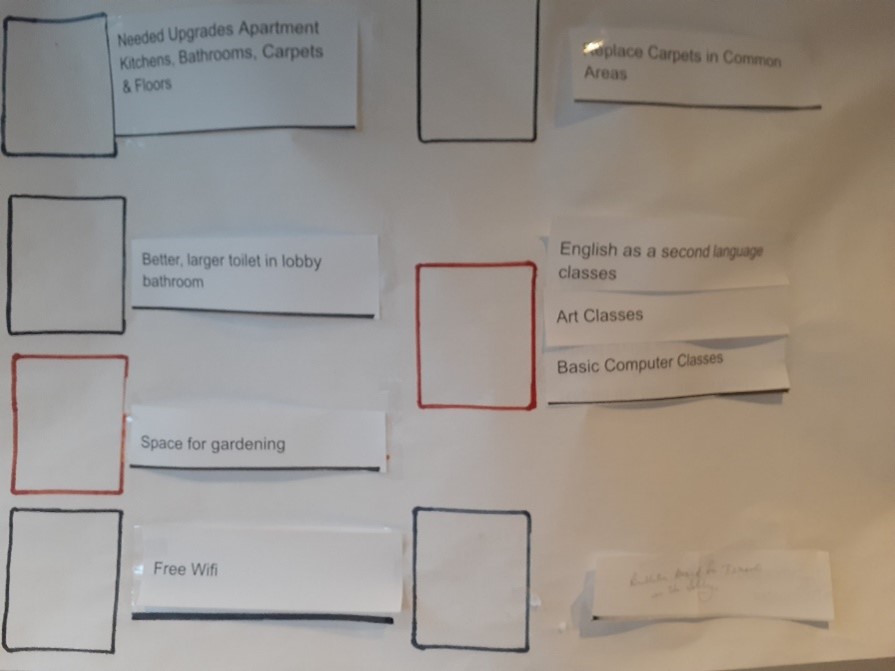
Once you have talked to as many neighbors as possible, you can bring everyone together to do a “Dot Exercise.” This will allow neighbors to collectively prioritize which issues they want to work on. We will cover this and the following steps in more detail in Part II of the Mel King Institute training.

Here is a snapshot of how the Dot Exercise works:

  1. At a meeting, genrrate a list of issues from residents, such as parking, sanitation, safety, schooling, etc. on a whiteboard or easel.
  2. Once you have a full list, count the number of issues.
  3. Divide the number by three. Give each resident this number of stickers. For example, if twelve issues are listed, each resident gets four
  4. Residents can then place the stickers next to the issues they think are most important. They can place them all next to one issue, or spread them out.
  5. Review the stickers to get a snapshot of which issues are most widely felt.

Step 3: Prep to Meet with the Executive Director (ED)

  • Set a standard time for your meeting with the ED, for example every third Monday of the month.
  • Set a standard time for the LTO Board to prepare for the meeting, for example the Friday before the meeting.
  • At the prep meeting, review any commitments the ED has already made and be prepared to follow up.
  • Prepare the list of goals (new or ongoing) and questions you will raise. This will be informed by Steps 1 and 2 above.
  • Decide who will speak about what.

No one should attend the meeting with the ED unless they attend the prep session. No one should bring up an issue unless it has been approved by the group.

Step 4: Meet with the Executive Director

  • Stick to your prepared agenda.
  • Write down everything the ED says, especially what she or he promises to do in response to your goals. It is essential to keep track of whether the ED says yes, no, or maybe.
  • Don’t feel pressure to solve the Housing Authority’s obstacles. Present your goals and keep presenting them until you win or change your goal. See the sidebar.

Step 5: Report Back through the Newsletter

As soon as possible after the meeting, write up the newsletter to report to the rest of the community about how things went.

  • Share the issues that were discussed and what the ED said she or he would do about them.
  • Make the newsletter as fun and accessible as possible. Use clip art or other graphics.
  • This written record is extremely important for two reasons. First, it holds the Housing Authority accountable. Secondly, it provides transparency, so all residents know what is going on.

Results

  • Tenants have resolved many issues as a result of this process.
  • With each small or medium-sized victory, quality of life improves. Often, the atmosphere in the building becomes more “homey,” and the power of the tenant organization grows.
  • As the tenants build more power, they will be able to tackle bigger and bigger problems.

Mass Union Network Leader Training Program

Timeline: April – June 2024

Payment: Participants in good standing will be paid $250 on April 30 and $250 on June 30, 2024.

Requirements:

    1. Attend the five-part LTO training series in April and May over Zoom, and think about what it would be like to facilitate the sessions (7.5 hours)
    2. Attend a debrief with other Network Leaders in Training (1 hour)
    3. Attend the three-part “Boot Camp” training series over Zoom in June, and think about what it would be like to facilitate the sessions (4.5 hours)
    4. Place follow-up call(s) to Boot Camp participants to check in and provide support (1-2 hours)
    5. Pass a short quiz about LTO participation regulations (<1 hour)
    6. Attend a final debrief session (1 hour)


760 CMR Update

The Executive Office of Housing and Livable Communities has released updates to its regulations that govern tenant participation and other important topics. Mass Union is reviewing the updates with input from our attorneys at Mass Law Reform and Legal Aid. You can see the proposed changes here.

The changes include a huge win for tenants: state Tenant Participation Funds will be going up from $6 to $25/unit/year! This change is based on YOUR VOICE being heard by Secretary Augustus and other state officials. Give yourself a pat on the back and stay tuned.

Mass Union’s Policy Committee will be discussing the proposed changes in the coming weeks so that we can submit a comment during the open comment period. To join the discussion, email Ben Echevarria (ben@massunion.org).

Mass Union Board of Directors Special Election

The Mass Union Board of Directors has decided to hold a special election to fill four open Director seats. The election will be held at the Spring Convention on May 19, 2024.

At the Convention, there will also be an Officer election to fill the five Officer positions: President, Vice President, Treasurer, Secretary, and Assistant Treasurer. The Officer election is open only to the current members of the board. Officer nominations will be circulated to our affiliates in March as part of our Convention mailing.

Members of our affiliates may run for the open Director seats. Nominations are due on March 1, 2024. Please see information about eligibility on page 6 of our bylaws. The Election is being overseen by an impartial Election Committee made up of people who are not running for a seat. Director Nicole Beckles is the Chair of the Committee. Affiliates may also join the Committee! If you would like to join the Election Committee, please email info@massunion.org.

How to Run

You may nominate yourself or another eligible member of one of our affiliates. If you nominate someone else, we will confirm that they would like run before circulating their nomination.

Submit the nominee’s name, contact information, and the name of her/his affiliate (LTO) to info@massunion.org by 5pm on March 1, 2024. If you wish, send us a photo and brief statement (not to exceed one half page) about the candidate.

Please keep an eye out for emails with additional information about the Convention. The full Convention registration packet will be mailed in March. If you have any questions in the meantime, please feel free to reach out.

Webinar Recording: Using Your Grievance Process

Policy Update: Good Things are Happening

It’s the holiday season and we have good news to share. Mass Union recently met with Ben Stone, the head of the Division of Public Housing at EOHLC, along with two members of his staff. (EOHLC means the “Executive Office of Housing and Livable Communities,” which is the new DHCD.) We are happy to report that EOHLC is planning some changes that will benefit tenants!

#1: Tenant Participation Funds

While we are still awaiting more details and confirmation, EOHLC has indicated that they will be raising the state tenant participation funding level to match the federal level of $25/unit/year. This is more than four times as much as the $6/unit/year state tenants are getting now!

#2: Tenant voice in Management Agreement decision-making

EOHLC is also working on a Public Housing Notice that will ensure that tenants have a voice when Local Housing Authorities (LHAs) are considering entering into “Management Agreements.”

What is a Management Agreement? Instead of hiring their own Executive Directors, some LHAs enter into a contract with another LHA to manage them. These are known as Management Agreements. As of now, LHAs can enter them without providing notice to tenants or seeking LTO input. We are working with EOHLC to ensure that tenants have a voice in this important decision-making.

Once there is more information to share, we will let you know. Please stay tuned!

Reminder: Other Policy Updates

Mass Union has nine policy areas that we are working on. Several are being addressed directly by EOHLC through regulations or guidance, as mentioned above. In addition, two of our priorities are addressed in the Affordable Homes Act, also known as the bond bill. Read our statement about the Affordable Homes Act here. We will be working on the bond bill throughout the spring and summer, until it is passed, to ensure that the full $1.6 billion is allocated for capital repairs in public housing, and tenants are guaranteed protections during redevelopment. We shall also joining with others to call for Access to Counsel be added to the bond bill so that low-income tenants facing eviction can have the legal representation they need.

Coming Up: Mass Union Meeting with the Division of Public Housing at EOHLC

Mass Union is excited to meet with Ben Stone, the head of the Division of Public Housing at EOHLC, next week. (EOHLC means the “Executive Office of Housing and Livable Communities, which is the new DHCD.) We have several agenda items we are planning to discuss, based on input from tenants across the state. Here is our agenda:

  1. The status of regulatory updates to rent and other topics that were begun before COVID
  2. Problems with the town tenant LHA board member appointment process
  3. Increasing state Tenant Participation Funding to $25/unit/year, in order to match federal housing
  4. Making sure tenants have a say in Housing Authority management agreements and mergers before they happen
  5. Highlighting and enforcing grievance regulations

Stay tuned for an update about the meeting later in December.

Other Policy Updates

  1. Mass Union has nine policy areas that we are working on. Two of them are addressed in the bond bill, which is officially called the Affordable Homes Act. Read our statement about the Affordable Homes Act here. We will be working on the bond bill throughout the spring, until it is passed, to ensure that the full $1.6 billion is allocated for capital repairs in public housing, and tenants are guaranteed protections during redevelopment.
  2. Last week, Mass Union board chair Dave Underhill sent this letter to Governor Healey and high-ranking members of her Administration, such as Secretary Augustus. We asked Governor Healey to provide $189 million for public housing in the FY25 operating subsidy, and to fund our other priorities.
  3. If you’ve read this far, consider joining Mass Union’s policy committee! We meet every other Friday to advance our policy agenda. Contact Ben if you are interested, ben@massunion.org.

Social Media Terms of Use

Mass Union’s Facebook Page

Like our Facebook Page here!

Please note that the administrators of our page have the right to hide and delete comments and remove followers from our page for violations of our Terms of Use. These are our Terms of Use:

1. Be kind and Courteous

We’re all in this together to create a welcoming environment. Let’s treat everyone with respect.

2. No Hate Speech or Bullying

Make sure everyone feels safe. Bullying of any kind isn’t allowed, and degrading comments about things like race, religion, culture, sexual orientation, gender or identity will not be tolerated.

3. No Promotions or Spam

Give more than you take to this community. Self-promotion, spam and irrelevant links aren’t allowed.